0.
I just finished my evening walk, taking a little time to recharge. The sunset was exceptionally beautiful today with its orange rays, and as much as I hate to say it, I’ll probably say the exact same thing about it again tomorrow when it changes to a soft pink.
I like that when we walk, we see different faces, different activities, different background noise, and to an extent, different textures to the neighborhood every single block. It seems like everything around us is constantly moving, reacting, and changing its color. It looks relentless. At some points, it also makes me wonder why we are not getting bored of the similar activities we do everyday? Is the circle too repetitive that we don’t really bother to care?
I think the truth is that we only notice a loop when it breaks. Maybe we don’t notice the repetition because we are too busy relying on it. Beneath all the shifting colors of the sunset and the changing textures of the streets, there is an invisible, silent rhythm that keeps our personal worlds from spinning out of control. We are built on loops.
... until something disrupts them.
1.
Have you ever noticed, when you have the flu, that no matter how far a fever climbs, your body almost always finds its way back to the average baseline of 37°C? Or that when you hold your breath long enough, something inside you eventually forces a gasp of air? Or have you ever seen your cats chase a sunbeam across the floor, settle into it, shift away when they get too warm, drift back a few minutes later, over and over again?
Now, you may ask, is all of this purely accidental?
Lately, I’ve been keeping myself busy with a chaotic mix of things: learning, job applications, news, and personal growth. At some point, my brain’s dopamine pathways were just so fried. The focus went quiet, not dramatically, but in the way, I might say, a signal degrades when the channel is too noisy. I often, subconsciously, found myself dimming the lights, taking longer walks, or re-watching my favorite, comforting shows. The ultimate restoration period I could ever ask for was a deep sleep. And then, after a few days of that, something settled back. The focus came back. The interest came back. I sat down, and the work eventually felt like mine again.
You see, it is somewhat interesting how almost everything inevitably drifts back to its own default setting. In biology, there is a precise term for what we have discussed so far.
Homeostasis.
2.
Before the late 1840s, the dominant scientific belief was that nature operated on a strict, neat division of labor: plants were the sole creators of nutrients (capable of synthesis and building complex molecules like sugar and starch) while animals were purely the destroyers (only capable of breaking down, oxidizing, and burning those substances for energy). So, animals (including us humans, scientifically and biologically) were thought to be completely incapable of creating or synthesizing complex substances on their own.
Then, someone challenged this idea.
A pioneering French physiologist working in Paris named Claude Bernard (1813-1878) performed a series of experiments that would later overturn the old, basic assumption with his discovery of the glycogenic function of the liver. In 1856, following his groundbreaking work on the pancreas, he discovered glycogen, a white, starchy substance stored right in the liver tissue. Bernard initially termed it la matière glycogène (the sugar-forming matter) before characterizing it as glycogen in 1857. He realized that the liver wasn’t just a passive organ waiting for external input, but actively manufacturing and storing glycogen as a dynamic reserve that could be broken down to glucose as needed.
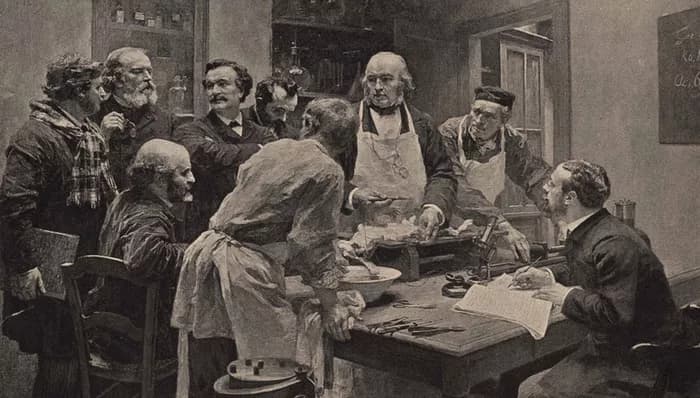 Une leçon de Claude Bernard “The Lesson of Claude Bernard”, an 1889 oil painting by Léon-Augustin Lhermitte
This observation led Bernard to a much larger idea. He called it milieu intérieur, the internal environment. His argument was straightforward: the constancy of the internal environment is the condition for a free and independent life. It essentially means that the reason complex organisms can survive in an unpredictable world is precisely because they maintain a stable internal world. The freer the organism wants to be externally, the more tightly it must regulate internally.
Fast forward to 1926, an American physiologist Walter B. Cannon (1871-1945) built directly on Bernard’s work, and suggested a name for the phenomenon: homeostasis. He paired the Greek words homoios (ὅμοιος), meaning similar, and stasis (στάσις), meaning standing still.
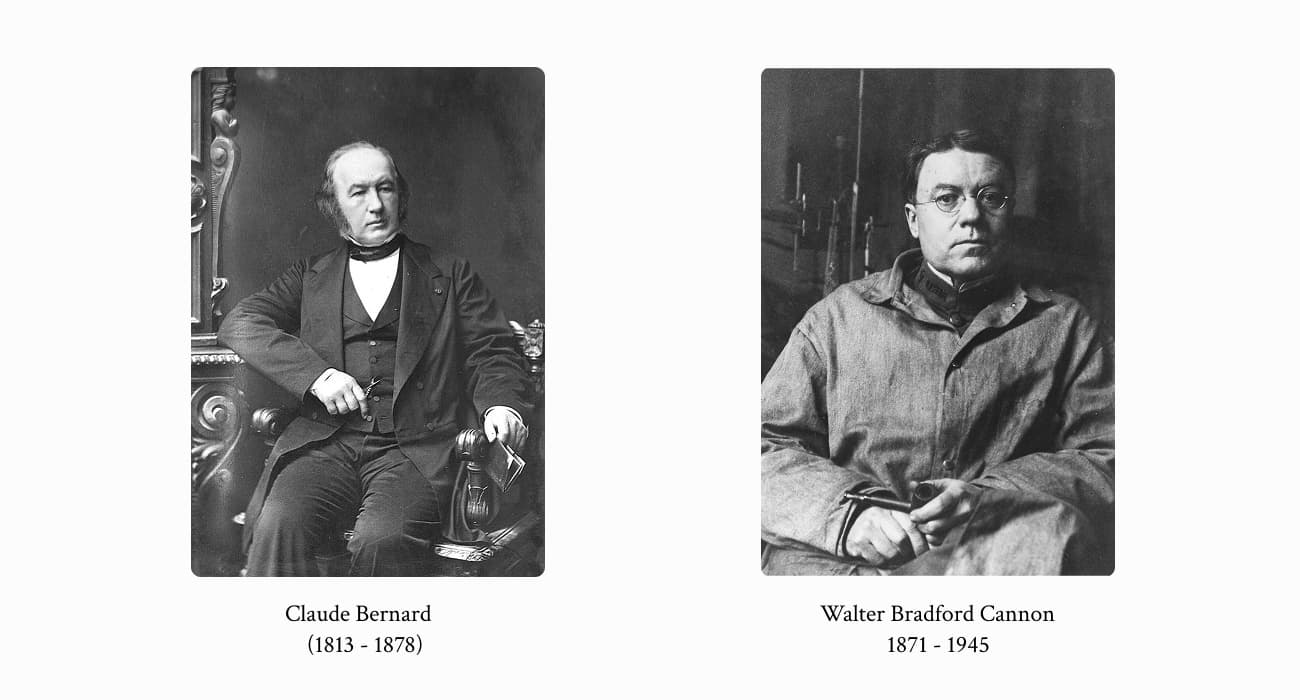
He later expanded it in his book The Wisdom of the Body. Cannon clarified that homeostasis does not mean a system is frozen, stagnant, or locked in place. As he wrote in his book and I quote, “the word does not imply something set and immobile, a stagnation. It means a condition—a condition which may vary, but which is relatively constant.” That distinction matters more than it might seem. The body is never perfectly still. It’s the frantic, invisible paddling beneath the surface that allows everything on top to look beautifully calm. And I think the term dynamic equilibrium is one way to put it.
Homeostatic regulation can be found in body temperature, blood pressure, blood glucose, levels of oxygen and carbon dioxide in the blood, pH, fluid balance, etc. It is important to note that these regulations commonly operate through negative feedback. To put it simply, it is a mechanism that the body uses to counteract physiological changes in order to maintain a stability and balance: when a system goes too high, it pulls it down; when it goes too low, it pushes it up.
By now, I think this concept has become something much bigger than just a phenomenon in biology. I hope you think the same. Homeostasis has long been a profound framework for how we navigate existence. The pattern surely extends beyond individual organisms.
3.
After his awakening, the Buddha gave his first teaching. It was not about the enlightenment or the nature of suffering. It was about balance. He delivered what became known as Majjhima Patipada, the middle way, to five former companions in the deer park at Sarnath, and the heart of it was deceptively simple: he had lived as a prince surrounded by luxury, then spent years as a severe ascetic, reportedly starving himself until, by his own account, he could feel his spine through his stomach. Neither worked. What the two extremes (self-indulgence and self-mortification) had in common was that both were unsustainable. He advocated that the Middle Way was not a weak compromise between the two, but rather the recognition that the path had to be one a person could actually walk, indefinitely, without destroying themselves in the process.
Another story, I think, is about a 🪕 lute, a metaphor to which the Buddha returned later, in advice he gave to a monk named Sona who had thrown himself into a walking meditation with such intense, unrelenting effort that his feet began to crack and bleed. Seeing this, the Buddha asked him:
“Tell me, Sona, in earlier days were you not skilled in playing the lute?”
“Yes, Lord.”
“And tell me, Sona, when the strings of your lute were too taut, was then your lute tuneful and easily playable?”
“Certainly not, Lord.”
“And when the strings of your lute were too loose, was then your lute tuneful and easily playable?”
“Certainly not, Lord.”
“But when, Sona, the strings of your lute were neither too taut nor too loose, but adjusted to an even pitch, did your lute then have a wonderful sound and was easily playable?”
“Certainly, Lord”
What you just read here can be used to apply to nearly everything worth doing. I think what makes this idea as a whole so profound is its simplicity. In a world that constantly pushes us toward reckless extremes, the hardest and most radical thing we can do is to have the courage to walk a path we can actually sustain.
4.
While writing this post, I stumbled upon another ancient echo from thousands of miles away. Around a century or so after the Buddha, across the Mediterranean, the Western world was arriving at almost the exact same conclusion.
In his Nicomachean Ethics, Aristotle (384-322 BC) introduced what philosophers called the Golden Mean. He argued that human virtue is never an absolute, rigid extreme, but rather a delicate balance between two opposing vices: excess (too much) and deficiency (too little). To him, being brave wasn’t about running foolishly into a hopeless battle (that’s rashness); nor was it about fleeing in fear (that’s cowardice). True courage lives in the middle, and virtue is the sweet spot where a trait is tuned precisely to what the situation demands.
Speaking of Aristotle, I think there is a fascinating historical irony here. Aristotle famously tutored the young Alexander the Great. But if you look at history, Alexander did not exactly live a life of homeostatic balance (yet severe, chronic allostatic load, I might say.) He went on to conquer the known world, driven by an insatiable, relentless ambition that pushed his army, his mind, and his body to the absolute brink. He pulled his own strings so tight that they eventually snapped as he died at the age of 32.
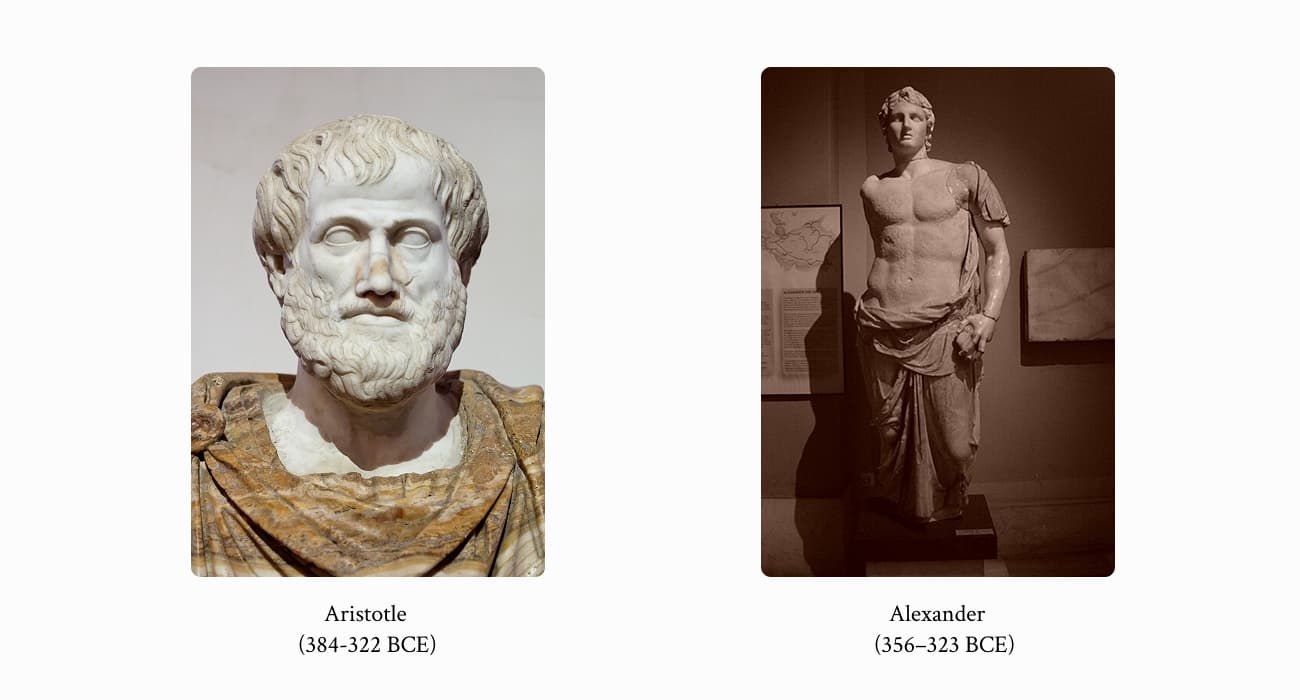
However, I would argue, the real irony here isn’t that the student failed to implement the teacher’s lesson, but rather a tragic paradox that the man who conquered the world could ultimately not conquer his own inability to find the middle ground. It feels almost unfair to say, but his life forces a difficult question. This reminds me of what G.H. Hardy wrote in his famous 1940 essay, A Mathematician’s Apology, “Good work is not done by ‘humble’ men.”
Maybe human breakthroughs require a temporary betrayal of our internal balance.
5.
So, is any of this accidental?
I don’t think so. I think the cats know something we keep having to relearn. They don’t overthink the sunbeam: they just move when they need to, and drift back when they’re ready.
I’ve been thinking about that a lot, especially during the weeks when I felt most scattered. At some point, I stopped fighting the exhaustion, and just let myself rest. Things eventually got better.
I didn’t plan that recovery. My body did. My nervous system did. The same mechanism Bernard found in the liver, the same principle the Buddha was pointing at with the lute, the same thing Aristotle was describing about means and virtues. It was just homeostasis, doing what it always does, pulling things back toward a range where life is actually possible.
I think the part that stays with me the most is what Bernard wrote, that the fixity of the internal environment is the condition for the free, independent life, which is a formal way of saying you can’t move freely in the world if you have no stable place to come back to. I think that’s more of the practice, not the destination.
Noticing when you’ve drifted. Making small corrections. Trusting that the system, if you don’t fight it too hard, knows the way back.
The cat certainly does.